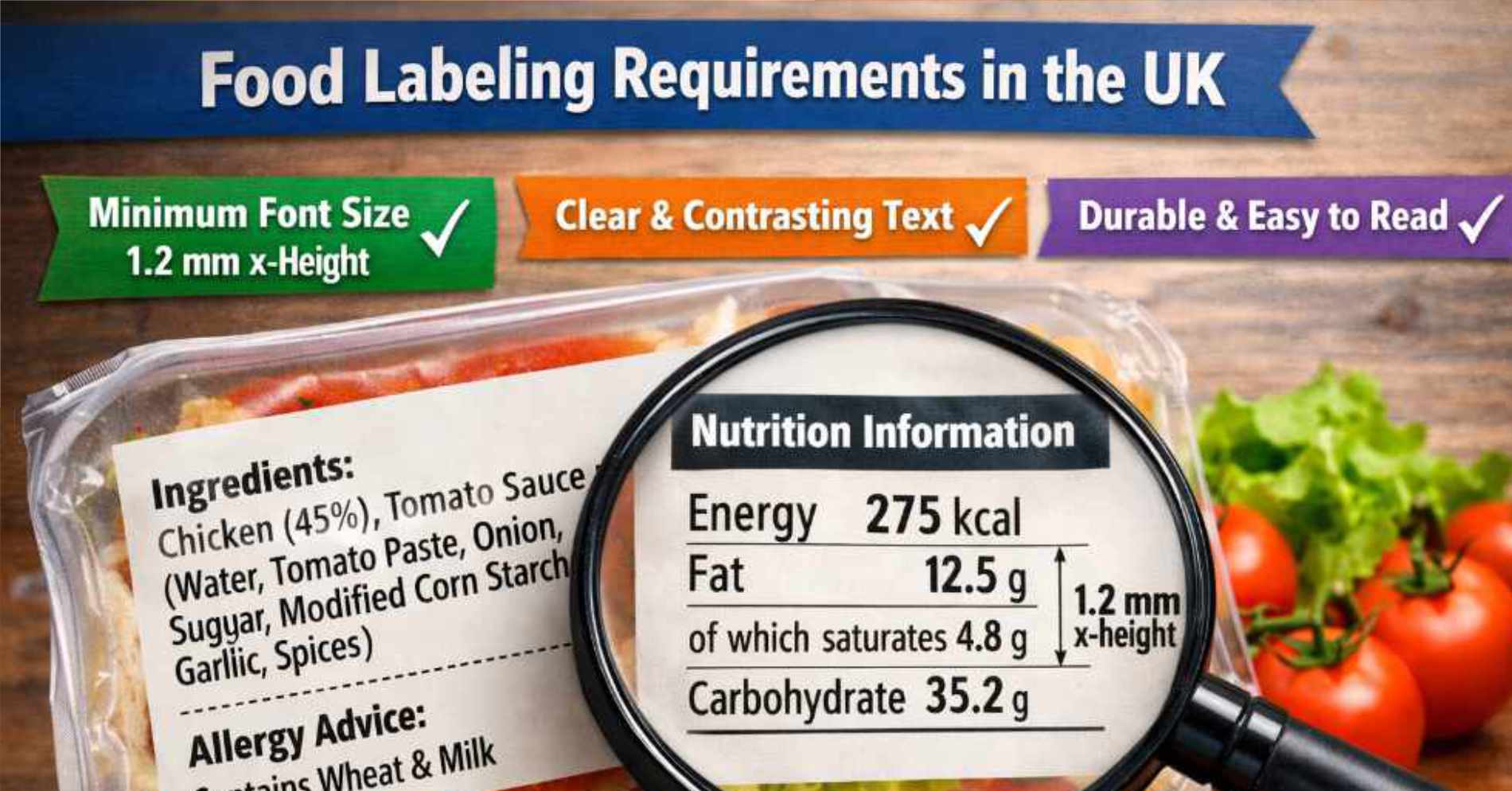
Food Label & Packaging Compliance: Navigating UK Food Labelling Regulations
| April 28 2026As a food business owner in the UK, you juggle sourcing ingredients, managing staff and satisfying customers. Food label compliance may feel like just another administrative hurdle, yet it is central to consumer safety, brand integrity and legal responsibility.
The UK combines retained EU legislation with domestic regulations, and failure to comply can result in improvement notices, product recalls and legal action. This guide demystifies UK food labelling regulations, outlines mandatory requirements and offers practical tips for small and large operators alike.
As a Sheffield-based family business with more than 50 years of experience in food packaging, B&P Wholesale understands how vital accurate labelling is and supplies a range of compliant packaging products.
Key Takeaways
Clear, accurate and complete information is legally required on every packaged product. Labels must include the food’s name, full ingredients list, allergens highlighted, net quantity, date mark, manufacturer’s address and country of origin. UK Food Information Regulations 2014 retain EU Regulation 1169/2011, meaning that non-compliance can lead to fines, recalls and damaged reputation.
Allergens and nutrition declarations demand special attention. Natasha’s Law requires full ingredient lists with 14 regulated allergens emphasised on pre-packed for direct sale (PPDS) foods, while the proposed Owen’s Law will extend clear allergen information to non-prepacked foods. Nutrition tables must follow a set format.
Different categories of food have different labelling obligations. Prepacked foods require comprehensive labels, non-prepacked foods generally need allergen signposting and loose foods have simplified rules, whereas PPDS foods must display ingredients and allergens as of October 2021.
Complying with labelling rules protects consumers and builds trust. Beyond avoiding penalties, clear labels help people with allergies and dietary restrictions make safe choices and support public-health goals like reducing obesity.
Understanding the Regulatory Framework
Food Information Regulations (FIR) 2014 and Retained EU Regulation 1169/2011
The backbone of UK food labelling law is the Food Information Regulations 2014. These domestic regulations implement the retained EU Regulation 1169/2011 on the provision of food information to consumers.
Information must be accurate, clear, easy to understand and legible.
Labels must be in English and indelible.
The food’s name must be legal, customary or descriptive.
A full ingredients list is required for multi-ingredient foods.
Following Brexit, regulatory divergence has emerged. In Great Britain the retained EU Regulation applies with amendments, while Northern Ireland continues to follow EU law under the Northern Ireland Protocol.
Natasha’s Law and PPDS Foods

Source: https://www.bbc.com/news/uk-58756597
Prompted by the tragic death of teenager Natasha Ednan-Laperouse, Natasha’s Law came into force on 1 October 2021. It requires all Prepacked for Direct Sale (PPDS) foods to display a full ingredients list and emphasise all allergens.
Owen’s Law and Non-Prepacked Foods
Owen’s Law, still awaiting full legislative implementation, will extend clear allergen information to non-prepacked foods sold loose or made to order.
Role of Regulatory Authorities
Food Standards Agency (FSA): Oversees food safety, allergen control and labelling enforcement.
Department for Environment, Food & Rural Affairs (DEFRA): Develops policy on food labelling in England.
Local authorities: Conduct inspections, issue improvement notices and initiate prosecutions where necessary.
Mandatory Food Label Requirements
1. Name of the Food
The product name must be clear and not misleading.
2. Ingredients List
Foods containing two or more ingredients must list all ingredients, including water and additives, under the heading “Ingredients”.
3. Allergen Information
Fourteen allergens must be clearly declared and emphasised.
4. Quantitative Ingredient Declaration (QUID)
When an ingredient appears in the product name, is emphasised through images or is essential to characterise the food, its percentage must be declared.
5. Net Quantity
Packaged foods over 5 g or 5 ml must display the net quantity in grams, kilograms, millilitres or litres.
6. Date Marking
Labels must indicate either a “use by” date or a “best before” date.
7. Name and Address of Food Business Operator
The label must include the business name and physical address.
8. Country of Origin or Place of Provenance
Country of origin must be declared when omission might mislead consumers or when required for specific categories.
9. Nutrition Declaration
The “big 7” nutrients must appear in a prescribed order.
10. Special Warnings and Additional Requirements
Additional warnings are mandatory for particular products.
Food Categories and Their Labelling Obligations
Prepacked Food
Prepacked foods are sealed before being offered for sale.
Non-Prepacked (Loose) Food
Non-prepacked foods include items sold loose or packaged at the customer’s request.
Prepacked for Direct Sale (PPDS) Food
PPDS foods are packaged on the same premises where they are sold.
| Requirement | Prepacked | Non-Prepacked | PPDS |
| Name and description | Required | Notice or sign | Required |
| Ingredients list | Required | Not required | Required since Oct 2021 |
| Allergen information | In ingredients list | Written/verbal signposting | In ingredients list |
| Date mark | “Use by”/“Best before” | Not required | Required |
| Net quantity | Mandatory over 5 g/5 ml | Not required | Not required |
| Business name & address | Required | Not required | Not required |
| Nutrition declaration | Big 7 required | Not required | Not required |
| Country of origin | Mandatory for meat, fish, honey | Specific meats only | If omission misleads |
Designing Compliant Food Labels
Legibility and Presentation
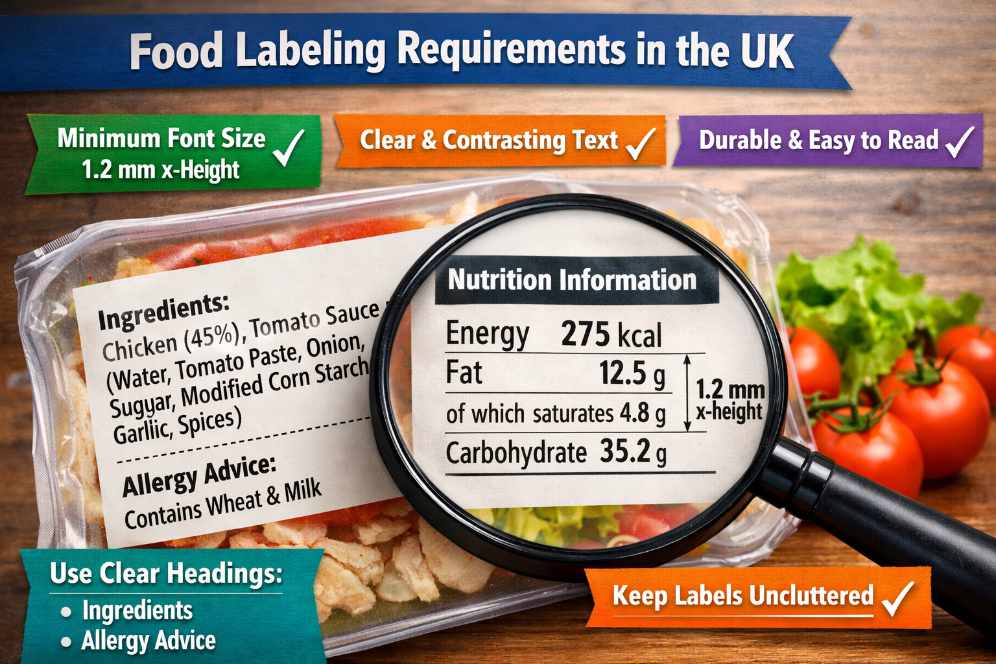
Information on food labels must be legible and presented in a minimum font size of 1.2 mm x-height.
Allergen Highlighting
Highlight allergens consistently throughout your product range.
Nutrition Tables
Follow the “big 7” order and provide values per 100 g/ml.
Use of Claims
Nutrition and health claims are tightly regulated.
Allergen Management in Production
Accurate labelling is only part of allergen management.
Digital Labelling and Emerging Trends
QR Codes and Smart Labels
QR codes can direct consumers to expanded ingredient lists, provenance data, nutritional analysis and sustainability information.
Sustainable Packaging and Eco-Labelling
Consumer demand for environmentally responsible products is rising. Eco-labels communicate environmental credentials.
Anticipating Regulatory Changes
The regulatory landscape evolves. Proposed Owen’s Law will enhance allergen disclosure for non-prepacked foods.
Practical Steps for Small Businesses
Audit your products. Categorise each item as prepacked, non-prepacked or PPDS.
Create standard templates. Use consistent label formats.
Verify ingredient and allergen data. Source accurate information from suppliers.
Train staff. Ensure employees understand labelling rules.
Use quality packaging. Select packaging that preserves food quality and provides sufficient space for legible labels.
Review and update. Regularly review your labels against current legislation and guidance.
At B&P Wholesale, we understand these challenges firsthand. Our family-run business has supplied eggs and food packaging solutions in Sheffield for more than 50 years.
When upgrading your labels, consider pairing them with packaging that enhances presentation and complies with UK regulations:
Bagasse and foil containers offer excellent print surfaces for labels and are ideal for PPDS foods.
Microwavable and plastic containers with secure lids allow clear labelling and maintain product integrity during transport.
Paper and plastic cups with lids can display essential allergen and nutrition information for beverages.
Our team can guide you on selecting containers that provide adequate space for legally required information.
Conclusion
Achieving food label compliance in the UK requires diligence, accuracy and ongoing vigilance. Clear labelling is not just a legal necessity — it is a commitment to transparency and care for your customers. As a Sheffield-based supplier with decades of experience, B&P Wholesale stands ready to support your compliance journey with high-quality packaging solutions and expert guidance.